
Until you reach the maximum magnification for your telescope, the brightness of stars in your telescope image is essentially determined by the diameter of the objective. For the full discussion on this see the page on Magnitude Gain. Extended sources, however, are a different matter entirely.
Brightness of an extended source, something that has a surface area, like a planet or a nebula, depends on the magnification you are using in your telescope. As the magnification of a telescope increases, each object covers a larger area of the image so the light that was collected for that object is spread over a larger area -- which means the light gets spread thinner -- and the surface brightness of the object drops.
Notice I use the term "surface brightness" to mean the brightness per unit area, or the brightness density, and this is the brightness that your eye perceives. The total brightness for the object... when you sum up all the light over its total area... stays the same.
Since the area goes as the radius of the object squared, the surface brightness drops as the increase in magnification squared. Conversely as you reduce the magnification the image gets brighter. This effect is easy to see, in fact it's a little disturbing, in a telescope with a zoom eyepiece.
So then I do have a reason for wanting to go to lower magnification -- I can increase the surface brightness, and therefore often the detectability -- of faint extended sources like emission nebulae.
The increase in brightness as you reduce magnification has a limit, and that limit is related to something called the exit pupil. The “exit pupil” is the cylinder of light coming out of the eyepiece, as shown in the diagram above. We can determine the diameter of the exit pupil, which we will call Dep, by examination of the diagram and noting that, by similar triangles,

(Note that I just drop the fe
from the term fO+fe since fe
is so much smaller than fO.)
So the exit pupil goes "inversely" with the magnification M, meaning that as M gets bigger, the exit pupil gets smaller, and, importantly, as M gets smaller, the exit pupil gets bigger.
Note: for the discussion on the formula for magnification, go to the Magnification Page.
What happens if I make the exit pupil bigger than your eye pupil? Well then not all the light gets into your eye -- I start throwing away light -- and even though I'm reducing the magnification, the surface brightness of the image is not getting any brighter. So the maximum surface brightness I can achieve is when the exit pupil has grown to just match the eye pupil, which is about 7 mm when your eye is adapted to the dark. The magnification to get this maximum exit pupil is my minimum magnification. Then if I use the equation above, and rearrange it a bit, I can find the minimum magnification, Mmin as

Because I don't get any increase in brightness past this point, and I only make the image smaller, there isn't really much point in going with a magnification that's any lower than this.
Here's the explanation, only presented for math lovers, engineers, and other peculiar people like us:
I used 7mm for the diameter of the eye pupil, so the number 7 shows up in these equations a lot. However... there's bad news for us geezers -- meaning anyone over 30 years of age. It's that the average diameter of the eye pupil reduces with increasing age. It gets smaller as you get older. This varies greatly from person to person, so the only way to know for sure is to actually measure your eye pupil while it's dark adapted, but the following table gives you a guideline.
| Age (years) | Pupil Size (mm) |
|---|---|
| 20 or less | 7.5 |
| 30 | 7.0 |
| 35 | 6.5 |
| 45 | 6.0 |
| 60 | 5.5 |
| 80 | 5.0 |
If you're matching the telescope performance to your eye, you could use the numbers above instead of assuming 7 as I did in the equations. That's just a guess, though. If you want to be really accurate there are a few ways to actually measure your dark adapted pupil diameter. So perhaps more correctly the formula for Mmin should be Mmin = DO/Deye. Then why am I not using that?
First of all, it means I'd be requiring you to figure out a way to measure your dark-adapted eye pupil, which is a non-trivial exercise. Secondly, I'm rarely the only one looking through my scope. Half the fun of observing is to be able to show other people the coolest stuff you've found. So I do my figuring based on other people, as well as my own eye, and 7mm is a pretty representative value. Thirdly, as you can see on the Surface Brightness Page, assuming a 7mm eye pupil makes calculating percent surface brightness a breeze.
Once we know the magnification we want, we can determine the eyepiece to get it. That comes from the magnification equation from the Magnification Page and our results above:

and since the f-ratio, fR of the scope is

then the focal length fe to get a given magnification M, when we know the exit pupil we want, is found by setting
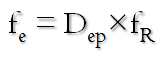
This is a very important result, as discussed here.
So then based on the above result, and given that we want the minimum magnification to give us an exit pupil that just matches a "typical" pupil diameter of 7 mm, the maximum eyepiece focal length is easily found as

The surprise in this result is that the maximum focal length eyepiece depends only on the f-ratio of my scope.
Just look at how cool these results are. If I know the diameter of the objective and the f-ratio of the scope, I can immediately identify the largest eyepiece focal length and smallest magnification that gives me the brightest image.
So for example, take my 6-inch, f/5 scope. Converting the diameter to metric, I have 6 × 25.4 = 152mm, so the minimum magnification is DO ÷ 7 = 152 ÷ 7 = 22.
Even easier is finding the brightest eyepiece, or fe-max, which is just 7 × fR = 7 × 5 = 35mm.
Since the largest eyepiece I have for this scope is 25mm, this gives me a clue that I might benefit from going a size up, like a 32mm eyepiece.
If I'm working with an enormous scope with an itty-bitty f-ratio, like an 18" f/4.5 Dobsonian, then the maximum focal length eyepiece I will find for this scope will come out relatively low -- in this case it's 7×fR = 7×4.5 = 31.5, and I'll end up picking a 32mm eyepiece.
Then when we work out the magnification with this eyepiece, we get M = DO/7, where DO on this scope is huge = 25.4×18 = 457.2mm, so M = 457.2/7 = 65.3. In an eyepiece with a fairly standard field of view FOVe of 52°, we get FOVscope = FOVe/M = 52/65.3 = 0.8°, and hey -- this is the widest field of view we're going to get with this scope. If we want to see a large cluster in its entirety, like the Pleiades with a diameter of about a degree and a half, we're out of luck.
Well, not entirely out of luck -- we can simply go with a longer focal length eyepiece and get a larger FOVscope. If we grab, say, a 55mm eyepiece with a 50° FOVe, then we get an exit pupil of Dep = fe/fR = 55/4.5 = 12.2mm, a magnification of M = DO/Dep = 457.2/12.2 = 37.4, and an FOVscope = FOVe/M 50/37.4 = 1.3°. We can just about get the whole Pleiades in the field of view. And as we noted above, the surface brightness is still 100%.
So why not just do that? Well, did you notice the size of that exit pupil? 12.2mm?? Your eye pupil is only 7mm, so 5.2mm of the light coming out through that 12.2mm exit pupil is being thrown away. When you compare area of the eye to area of the exit pupil, that's about two-thirds of the light being thrown away. That's a sign that you are not using the power of this scope as it was meant to be used.
Or to put it more simply, if you want to look at the Pleiades Cluster in its entirety, get a smaller scope.
Let's take a look at how this works out for my other scope, a 90mm f/13.9 ETX.
The minimum magnification is DO ÷ 7 = 90 ÷ 7 = 13.
Gee, it seems like for a telescope that's less than awesome, especially since my 10x50 binoculars just about match that in magnification.
Well, then, let's look at the maximum eyepiece focal length for this scope. fe-max = 7 × fR = 7 × 13.9 = 97.3mm.
Jumpin' Jehosephat! I don't think I could even find an eyepiece with a focal length like that. (That's right, try as you might you won't find an eyepiece that big.) So what happens when I get an impossibly big answer?
Well then, a surface brightness of 100% is simply impossible with that scope. Pick the longest focal length eyepiece you can find for the scope, in this case probably 40mm, and calculate the resulting surface brightness as explained on the Surface Brightness page.
In the exit pupil diagram above, you might notice that the exit pupil is positioned at a distance of fe from the eyepiece lens. The distance from the eyepiece to the exit pupil is called the "eye relief", and it shows how close your eye has to be to the eyepiece in order to see the entire image. This can be important when you're observing, especially for those of us who wear glasses.
In theory with only a single simple lens for an eyepiece, this actually is positioned at a distance ever so slightly longer than fe. However real eyepieces have multiple elements, notably a field lens that widens the apparent field of view of the eyepiece. This field lens also causes a shortening of the eye relief, so that for typical eyepieces the eye relief is somewhere around 70-80% of the focal length.
The eye relief is highly dependent on the specific eyepiece design, and can range from 10 to 90% of focal length, or, in the higher-end eyepieces, might be fixed at 12 or 20 mm. The precise value can only be known for certain from the manufacturer’s specifications.
Three points to remember about the eye relief, though:
 Back to Telescope Equations Home Page
Your questions and comments regarding this page are welcome.
You can e-mail Randy Culp for inquiries,
suggestions, new ideas or just to chat.
Updated 12 May 2019