
|
|
Introduction |
|
|
The Process |
|
|
Terms & Symbols |
|
|
Scope Equations |
|
|
Special Cases |
Stars are so unimaginably far away that the light we receive from them arrives in rays that are perfectly parallel. Your eye is designed to focus these parallel rays to a point, allowing you to identify where the light is coming from.

A telescope, in its original configuration (refractor), consists of two lenses. The first one, the objective lens, collects light and focuses it to a point. (Note that the objective mirror in a reflecting telescope does exactly the same thing.) The second lens, the eyepiece, catches the light as it diverges away from the focal point and bends it back to parallel rays, so your eye can re-focus it to a point.
Notice how the telescope has taken all the light passing through the objective lens and compressed it down to a column of light that will pass through the pupil of the eye. This is one of the three major tasks of the telescope, the full list being:

The equations on this page permit you to find just exactly how well the telescope will perform these tasks, and along the way I also show how the tasks are accomplished, by explaining both the theory and the practice. We will be talking specifically about visual observing through the telescope how the telescope and your eye work together. Understanding photography starts with understanding these ideas, and here we are going to stick to visual observation.
CAUTION - telescope manufacturers will often advertise the magnification of the scope, and give really big, impressive numbers. The problem is that the number is essentially meaningless.
The magnification of a telescope is a combined function of the scope and the eyepiece that is used, so the user can set the magnification to almost any arbitrary value by selecting a suitable eyepiece. Whether the resulting image is clear, or barely visible, depends on other properties of the telescope. Therefore the magnification is not the most important measure of a telescope.
What actually is the most important measure is the diameter of the objective, or more simply the scope diameter, because that determines both the resolving power (the smallest detail you can see) and the light-gathering power (the faintest objects you can see). How the scope diameter determines the performance of your telescope is explained through the equations below.
Of course you can use the equations below however you like. Just in case it seems like a lot of equations to you, or maybe looks a bit overwhelming, here's a procedure I can suggest for you. It's in two parts: first finding the intrinsic telescope properties, then determining its operating points.
 Determine the Telescope Properties
 These are properties of the scope that depend only on the diameter of the objective, so are intrinsic and fundamental to the scope.
 Determine the Operating Points
The goal is to bracket the range of eyepieces - largest and smallest focal lengths - to use with the scope and determine the performance of the scope at each end of the range.
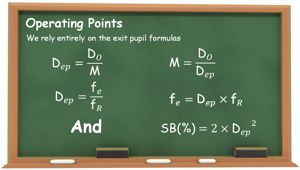
Click on the chalk board to see the process in action with various random interesting examples.
| Symbol | Meaning |
|---|---|
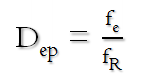
| Dep | Diameter of the exit pupil. The exit pupil is where the light leaving the eyepiece converges to its smallest circle -- you find the exit pupil when you bring your eye up to the eyepiece until you can see the whole image. |
| DO | Diameter of the objective. The "objective" can be either the large lens at the front of the telescope (in a refractor) or the large mirror at the back of the telescope (in a reflector). |
| fe | Focal length of the eyepiece. The distance from the center of the eyepiece lens to the point at which light passing through the lens is brought to a focus. |
| fO | Focal length of the objective. The distance from the center of the objective lens (or mirror) to the point at which incoming light is brought to a focus. |
| fR | f-Ratio. Simply the ratio of the focal length to the diameter
of the objective, or fO/DO. That means it's the
number of lens diameters from the lens to its focal point, as shown
below. This is written "f/" and then the value. Often given along
with the diameter of the objective to describe the scope. 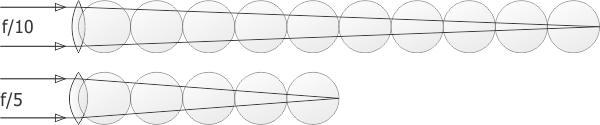
|
| FOVe | Field of view of the eyepiece. A measure of the area you can see when looking through the eyepiece alone. This is expressed as the angle from one side of the area to the other (with you at the vertex). The two parameters fe and FOVe are the two primary specifications for the eyepiece. |
| FOVscope | Field of view of the scope. Tells you how much of the sky you see in the image in the telescope. This is the distance from one side of the eyepiece image to the other, expressed in degrees or minutes of arc across the sky. |
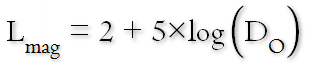
| Lmag | Star magnitude limit. The faintest star you can see in the scope, expressed in terms of star magnitude. The majority of visible stars have magnitudes in the range of 1-6, where the brightest stars have the lowest magnitude number, near 1, and the faintest you can see by eye are magnitude 6. The scope can show stars as faint as magnitude 16 or even higher (i.e. fainter), depending on its diameter. |
| M | Magnification. The apparent increase in size of an object when looking through the telescope, compared with viewing it directly. |
| PR | Resolving Power. The smallest separation between two stars that can possibly be distinguished with the scope. This is an indication of the finest detail the scope is capable of seeing -- regardless of the magnifying power. |
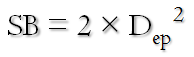
| SB | Surface Brightness. The brightness, or more correctly the brightness density, of bodies that cover an area, such as planets, nebulae and galaxies. These are distinct from bodies that appear as points, such as stars or asteroids. When an object has area, that area gets larger as magnification is increased, so the light is spread thinner. As a result surface brightness decreases with increasing magnification. |
So here they are, collected all together. Click on the "Explain This" button next to an equation to see the theory and practice to back it up -- how it came to be, what it means, and how to use it.
Note: I've made these equations as simple and easy to use as possible, so you can do most, if not all, of the calculations in the field in your head.
An important pointer: always work in millimeters. The fact that scope values -- especially the diameter -- are sometimes given in inches and sometimes in centimeters can make things more complicated than they need to be. Millimeters work out really well, so always convert if necessary. Multiply inches by 25 and centimeters by 10 to convert to millimeters.
| Term Computed | Equation | Theory & Practice |
|---|---|---|
| Resolving Power (in arcseconds) | 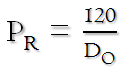 |
Explain This |
| Magnification | 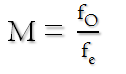 or or
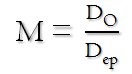 |
Explain This |
| Scope Field of View | 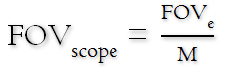 |
Explain This |
| Image Resolution What the Eye Resolves at Magnification M |
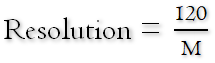 |
Explain This | Diameter of the Exit Pupil | 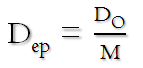 or or
 |
Explain This |
| Focal Length of the Eyepiece | 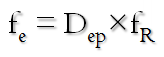 |
Explain This |
| Star Magnitude Limit Faintest Star Magnitude the Scope Can See |
 |
Explain This |
| Surface Brightness As a Percent of Maximum Brightness |
 |
Explain This |
| Term | Exit Pupil | M | fe | SB | Theory & Practice |
|---|---|---|---|---|---|
| Minimum Magnification Highest Brightness the Scope Can Deliver |
7 mm | DO/7 | 7×fR | 100% | Explain This |
| Wide-Field Magnification Balance of Performance for Deep Sky Observing |
5 mm | DO/5 | 5×fR | 50% | Explain This |
| Optimum Magnification Best Match of Scope & Eye |
2 mm | DO/2 | 2×fR | 8% | Explain This |
| Maximum Magnification Highest Detail the Scope Can Deliver |
1 mm | DO | fR | 2% | Explain This |
 Tutorial PowerPoint (2010 version)
Presentation of the Telescope Equations
This is how I teach the equations. Note that the full explanation for
each slide is in the notes.
Updated 21 April 2019.
 PowerPoint 97-2003 version Presentation of the Telescope Equations
 Tutorial PowerPoint (2010 version)
Presentation of the Examples Section
Tutorial PowerPoint (2010 version)
Presentation of the Examples Section
This is how I teach the examples. Note that the full explanation for
each slide is in the notes.
Updated 11 May 2019.
 Hans Sassenburg's Reference Excel
Contributed on 14 February 2024, contains the equations, calculations for selectable telescopes, along with brightness data on stars, planets, and deep sky objects.
Your questions and comments regarding this page are welcome.
You can e-mail Randy Culp for inquiries,
suggestions, new ideas or just to chat.
Updated 14 February 2024
 Go To Stargazing Page